The Four Blood Transfusions in Dracula—and Why They Matter
Lucy Westenra receives four blood transfusions in Bram Stoker’s Dracula. The donors are Arthur Holmwood, Dr John Seward, Professor Abraham Van Helsing and Quincey Morris.
Each man gives blood in a desperate attempt to replace what Dracula has taken. Each transfusion briefly restores Lucy. None can protect her from the next attack.
For a modern reader, the sequence is alarming for another reason. Dracula was published in 1897, before doctors understood the ABO blood-group system. Van Helsing repeatedly transfers blood from four untested donors into one patient without knowing whether their blood is compatible.
The result is one of the novel’s most powerful collisions between modern science and ancient horror. The transfusions are acts of love, dangerous medical experiments and clues to a mystery Stoker never fully resolves.
Who gives Lucy blood in Dracula?
The four donors appear in this order:
- Arthur Holmwood, Lucy’s fiancé
- Dr John Seward, Lucy’s doctor and former suitor
- Professor Abraham Van Helsing, the physician called in to investigate her illness
- Quincey Morris, Lucy’s American friend and former suitor
The order matters. It moves outwards from the man who expects to marry Lucy, through the men trying to save her, until all four are physically connected to her.
In the original text of Dracula, Van Helsing eventually counts “one, two, three” younger men who have opened their veins for Lucy, “besides one old man”. The old man is Van Helsing himself. The fourth younger donor, Quincey, has just completed the final transfusion.
The first transfusion: Arthur Holmwood
When Van Helsing first decides that Lucy needs blood immediately, Dr Seward volunteers. Arthur arrives before the procedure begins, however, and Van Helsing chooses him instead.
Arthur is young, strong and deeply devoted to Lucy. He is also her fiancé, making his blood seem symbolically appropriate to the Victorian men surrounding her. Van Helsing treats Arthur’s strength and emotional claim as signs that his blood must be suitable.
The operation appears to work. Colour returns to Lucy’s face while Arthur grows pale from the amount he gives.
This establishes the pattern for everything that follows: a man sacrifices part of himself, Lucy revives, and the apparent success persuades the doctors that they understand the problem.
They do not.
The second transfusion: Dr John Seward
Dr Seward becomes the second donor after Lucy again loses blood. He has medical training, but he is also emotionally involved: he proposed to Lucy before she chose Arthur.
Seward’s participation blurs the line between physician and patient. He is meant to record events objectively, yet he gives his own blood and becomes part of the case he is documenting.
This matters because Dracula is assembled from diaries, letters, telegrams and medical notes. Seward is not merely observing Lucy’s transformation. His body has entered the evidence.
The transfusion again seems successful, but the improvement is temporary. Dracula continues to reach Lucy despite the doctors’ treatment.
The third transfusion: Abraham Van Helsing
Van Helsing supplies the third transfusion when Seward is considered too weakened to give again.
He is older than the other donors, yet he accepts the same physical risk. The decision shows both courage and desperation. The professor has begun to suspect that Lucy’s illness cannot be explained by ordinary medicine, but he still attempts to fight it with a medical procedure.
Van Helsing therefore stands between two worlds. He uses instruments, drugs and transfusion while also turning towards garlic, crucifixes and folklore.
Lucy’s body becomes the place where those systems meet. Scientific intervention can restore what has been taken, but it cannot stop the supernatural force taking it.
The fourth transfusion: Quincey Morris
Quincey Morris provides the fourth and final transfusion.
Like Arthur and Seward, Quincey once proposed to Lucy. He expects no romantic reward and asks for no recognition. His donation is an act of loyalty to Lucy and to the other men.
By this point, however, the pattern is unmistakable. Lucy is repeatedly emptied and refilled. The men can replace the blood, but they cannot prevent Dracula from returning.
After Quincey’s transfusion, Lucy’s body responds less effectively than before. The treatment that once seemed to pull her back towards life is losing its power.
The failure is not caused by Quincey. It is the culmination of a struggle the men have misunderstood from the beginning.
Could four Victorian blood transfusions have saved Lucy?
Possibly—but they could also have killed her.
Doctors in the 1890s knew that blood transfusion could sometimes save a person suffering severe blood loss. They did not yet know why some transfusions succeeded and others produced catastrophic reactions.
Karl Landsteiner identified the main ABO blood groups at the beginning of the twentieth century. His work explained that mixing incompatible blood can cause red cells to clump and break down. A short history of that discovery is available through the US National Library of Medicine.
Van Helsing has no way to type Arthur, Seward, himself, Quincey or Lucy. He chooses donors according to youth, strength, health and character. Those qualities may sound reassuring, but they cannot establish blood compatibility.
One compatible transfusion might have helped Lucy survive blood loss. Four transfusions from four untested donors would multiply the uncertainty. A modern doctor would require blood typing, compatibility testing, screened blood and careful monitoring.
Stoker could not have known the ABO explanation when he wrote the novel. That makes the episode more unsettling, not less. The doctors are using advanced medicine at the edge of what their century understands.
Why do the transfusions fail?
Inside the story, the immediate answer is simple: the doctors replace Lucy’s blood, but Dracula keeps taking it.
The deeper answer is that they are treating the measurable consequence rather than the cause. They see pallor, weakness and failing circulation. They do not initially understand the marks on Lucy’s throat, her sleepwalking or the intelligence directing the attacks.
Their failure is not stupidity. Stoker makes them capable, committed and brave. The horror comes from watching intelligent people use the best explanations available while the truth remains outside those explanations.
That pattern still gives Dracula much of its force. New technology does not automatically defeat old terror. Sometimes it only measures the damage more precisely.
What do the four transfusions mean?
The transfusions carry several meanings at once.
Love becomes physical evidence
Arthur, Seward and Quincey all love Lucy in different ways. Van Helsing loves her through responsibility and compassion. Their feelings become literal material inside her veins.
The men create an accidental blood bond
Blood traditionally represents family, inheritance and identity. Lucy receives blood from four unrelated men, creating a strange artificial kinship before Dracula changes her again.
Science and superstition overlap
The transfusions are medically ambitious, while the defence against Dracula depends upon practices the doctors initially struggle to accept. Neither system is presented as sufficient by itself.
Lucy loses control of her own body
Men decide who may enter Lucy’s room, what treatments she receives and what her condition means. Dracula violates her, but the people trying to save her also turn her body into a contested space.
Blood may carry more than life
Stoker treats blood as nourishment, inheritance, sexuality, infection and spiritual corruption. The novel repeatedly asks whether identity can be transmitted through it.
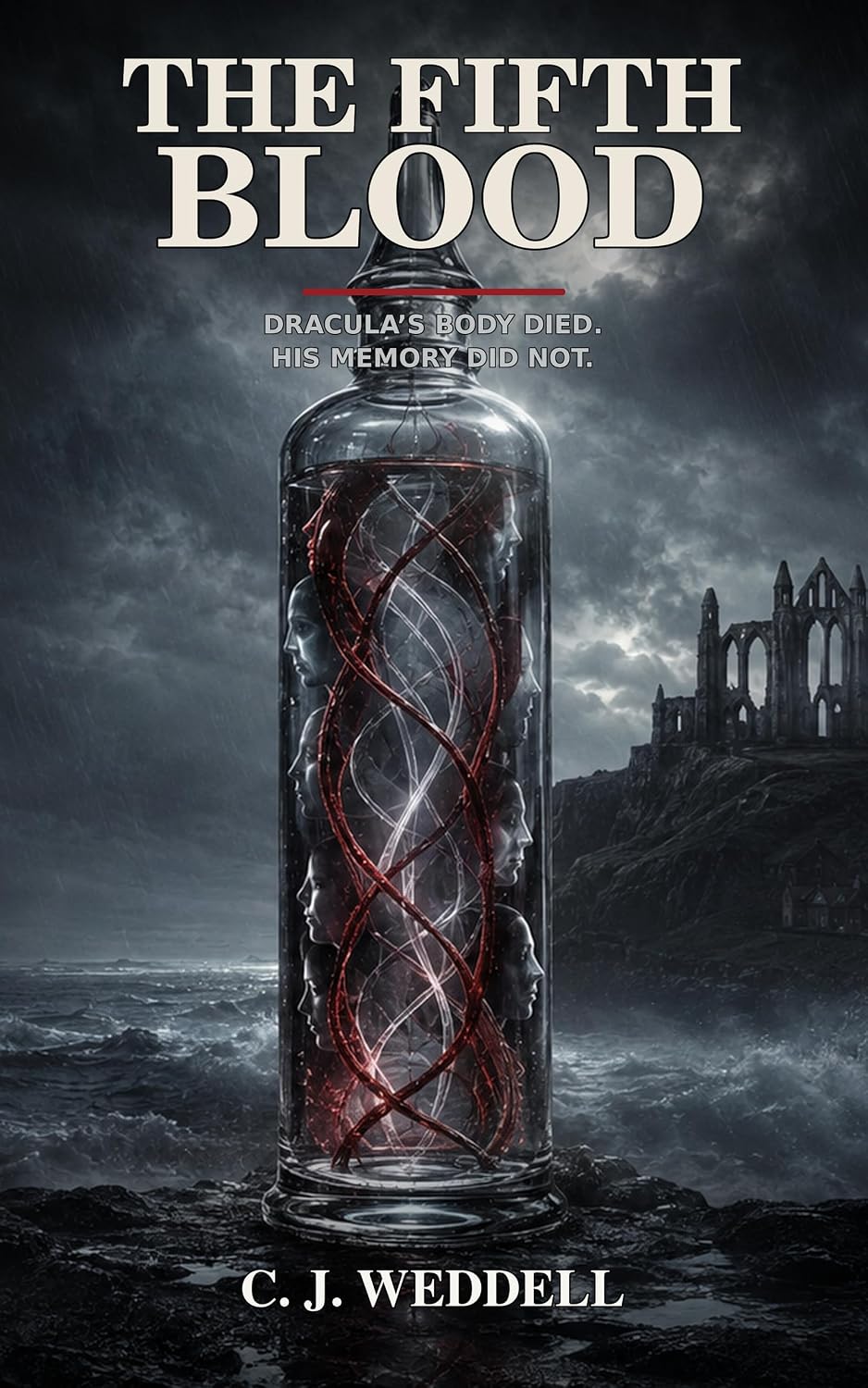
That final possibility is where The Fifth Blood begins.
Why the transfusions matter to The Fifth Blood
The Fifth Blood does not retell Lucy’s death. It follows the unanswered medical consequence of the four transfusions into modern Whitby.
Noah Creed wakes with two heartbeats and five donor profiles in his blood. Dr Mara Venn discovers that blood may preserve more than cells: donor identities, memories and a pattern reaching back to Van Helsing’s work in 1897.
The four canonical donors remain the foundation. The new mystery asks what their blood could have left behind—and what a fifth influence might make it remember.
That premise grows from a gap already present in Dracula. Stoker tells us who gave blood. He never tells us what became of everything those men placed inside Lucy.
The question hidden inside Lucy’s blood
The transfusion chapters are often remembered as medical set pieces on the road to Lucy’s transformation. They are more important than that.
They unite Lucy’s protectors, expose the limits of Victorian medicine and turn blood into a record of relationships. They also leave a disturbing question beneath the plot:
If blood can pass life from one person to another, what else might travel with it?
Read more about what happened to Lucy Westenra after Dracula, or discover The Fifth Blood and read its opening.
Four men gave Lucy Westenra their blood. A fifth made it remember.