Literary places / North Yorkshire
Why Whitby became Dracula’s perfect setting
A real harbour, a ruined abbey and the arrival of something unwelcome: how Whitby’s ordinary life gives Dracula its extraordinary atmosphere.
In this article
A seaside town is an excellent place to feel safe. There are windows full of things to buy, people going about their work and, somewhere, somebody being very firm about a parking space.
That is part of Whitby’s power in Dracula. The terror enters a recognisable place with ordinary routines. It does not politely remain in the distant castle where a reader might prefer to leave it.
Bram Stoker visited Whitby in 1890. Dracula appeared in 1897. Between the visit and the novel, the town became more than a memorable backdrop: it helped make the arrival of the Count in England feel disturbingly close to home.
What came from the real town?
English Heritage identifies several connections: Whitby’s abbey ruins and churchyard, Stoker’s reading in the local library, and the wreck of a Russian vessel called the Dmitry in 1885. The wreck helped inspire the novel’s Demeter.
Those are historical connections. The vampire and the dreadful voyage belong to fiction. The abbey and St Mary’s Church are also separate places, although their silhouettes can merge in a reader’s imagination.
Knowing that distinction makes the setting more interesting. Stoker used a place, its records and its atmosphere to make a new arrangement. A novel is allowed to do that; a historical account needs to say when it has.
The harbour makes arrival a problem
A harbour is built around an apparently helpful idea: things can come in from elsewhere.
In ordinary life that means trade, work, movement and the possibility of seeing something beyond your own street. In a Gothic story, it also means that a boundary can be crossed before anyone understands what is crossing it.
Stoker turns the ship’s arrival into a question about entry. The town can see a vessel and still fail to recognise what has reached it. That gap between witnessing an event and understanding it is one of the novel’s most effective sources of dread.
Read those scenes with that gap in mind. Ask what each observer can actually know at the moment they describe what they have seen.
The landscape gives the eye two stories
The coast permits a useful literary contrast: the familiar town below and the older, more exposed spaces above it.
A ruin suggests an earlier world still visible inside the present one. A churchyard asks a different question about time: who is remembered, who is absent, and what remains legible after a life has ended?
This is an interpretation of the setting, not evidence that a ruin must be haunted. Buildings are entirely capable of being old without harbouring anything more sinister than damp.
The Gothic pleasure comes from allowing a familiar view to acquire a second meaning. You can look at the same place twice and come away with a different story.
Familiar places make the intrusion sharper
A remote castle arrives with expectations. We have all been sufficiently warned by the staircase.
A holiday town works differently. People should be able to walk, talk, rest and make plans for tomorrow. When unease enters that setting, the reader has something ordinary to lose.
The strongest atmospheric fiction often protects those ordinary details. If every page announces doom, there is little left for doom to interrupt. Whitby offers light, social life and movement as well as darkness; the change in meaning is what gives the darkness force.
Read Whitby through the records
Dracula is assembled through different kinds of accounts. A useful way to revisit its Whitby passages is to keep three short notes:
- What is directly observed? Record the detail before deciding what it means.
- Who is interpreting it? Consider their knowledge, expectations and emotional state.
- What becomes significant later? Mark the moment a harmless-looking detail changes its role.
This keeps the reading curious without turning it into homework. There is no requirement to buy a special notebook. The back of an envelope has a distinguished investigative career.
A place to begin, not a claim about the whole town
Whitby has a history and present life far larger than one novel. Reading it solely through a vampire would make the real place smaller than it is.
The more interesting approach is to notice what fiction does with a place: what it preserves, what it rearranges and which question it leaves behind. In this case, the question is wonderfully uncomfortable. What happens when the danger has already arrived, but everyday life has not noticed yet?
Sources and further reading
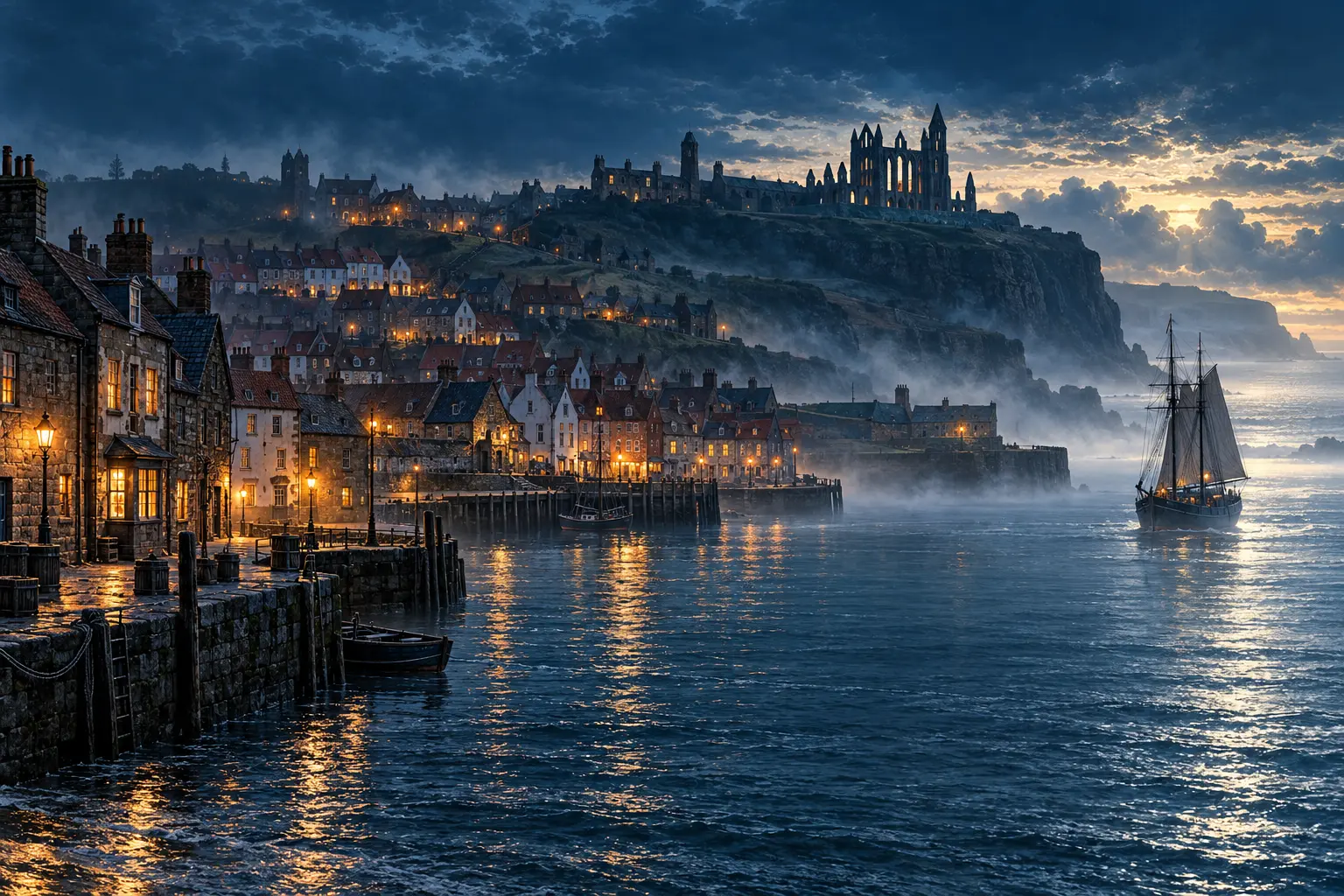
The historical connections above are drawn from English Heritage’s account of how Dracula came to Whitby. Read Stoker’s novel for the fictional events and documents. The landscape discussion is this journal’s literary interpretation. The accompanying artwork is an imagined coastal scene, not a documentary view or historical reconstruction.